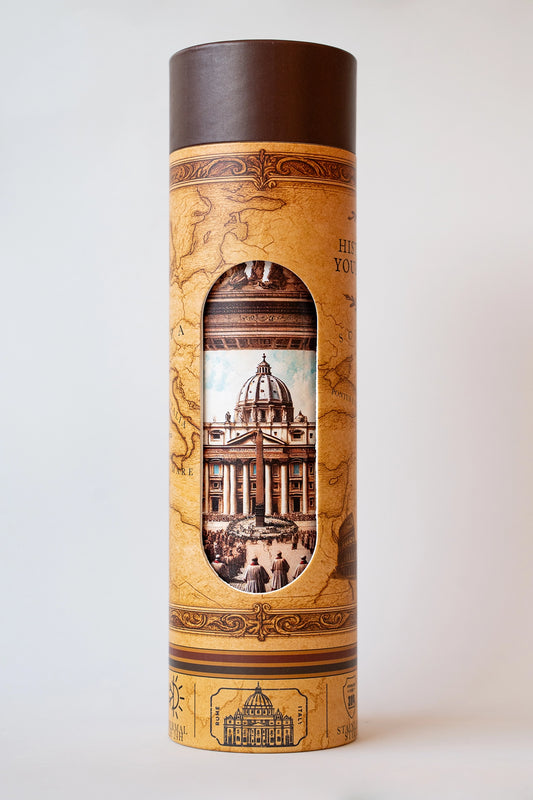
How to Visit the Vatican Museums in 2026: Tickets, Tips & Guide
Share
The Vatican Museums contain one of the greatest collections of art and antiquity ever assembled. They also contain, on any given morning in peak season, several thousand other tourists, navigating the same corridors with varying degrees of patience. Getting this visit right requires planning. Here is everything you need.
The Essential Facts
The Vatican Museums are not in Rome — technically. Vatican City is an independent state, and the museums occupy much of its territory. Entry is through the entrance on Viale Vaticano, a 10-minute walk from St. Peter's Square.
The museums are open Monday to Saturday, 9am to 6pm (last entry 4pm). They are closed on Sundays except for the last Sunday of each month, when entry is free — and consequently overwhelming with visitors. Avoid the last Sunday of the month unless crowds do not bother you.
How to Buy Tickets
Book online in advance at museivaticani.va. This is the official site and the most reliable option. Tickets are released 60 days in advance and sell out — particularly in spring and summer. Set a calendar reminder 60 days before your trip date.
Standard entry costs €20 per adult. A timed entry ticket removes the need to queue for tickets at the door; you will still queue briefly for security, which cannot be skipped.
Guided tours cost more but include a structured route through the collection and access to areas not always included in the standard entry. If this is your first visit or if you want context for what you are seeing, a guided tour is worth the premium.
Buy at P.Stops InfoPoints: if you are already in Rome and want to buy Vatican tickets in person without online booking fees, the P.Stops InfoPoint in Via Giuseppe Zanardelli — near Piazza Navona — sells Vatican Museums tickets directly. It opens at 8:30am, earlier than most tourist services in the area.
What to See — and How Much Time to Allow
The Vatican Museums are enormous: 54 galleries, 7km of corridors, and millions of objects. You cannot see everything. A well-planned visit concentrates on the highlights and does not attempt to cover the whole collection.
Minimum visit: 2.5–3 hours for the main highlights route (Egyptian Museum, Gallery of Maps, Raphael Rooms, Sistine Chapel).
Recommended visit: 4–5 hours, which allows time to pause and absorb rather than rush.
The Gallery of Maps is one of the most beautiful rooms in the world — 40 topographical maps of Italy painted directly onto the walls in the 16th century, the ceiling above them frescoed in extraordinary detail. Most visitors rush through it. Do not.
The Raphael Rooms are four rooms entirely frescoed by Raphael between 1508 and 1524, commissioned by Pope Julius II. The School of Athens — depicting the great philosophers of antiquity in an imagined architectural space — is considered among the supreme achievements of Renaissance painting.
The Sistine Chapel is the culmination of the visit. Michelangelo's ceiling (painted 1508–1512) and his Last Judgment on the altar wall (painted 1536–1541) are separated by 28 years and represent two entirely different artistic moments. Arrive knowing what to look for: the central panel depicting the Creation of Adam, the prophets and sibyls around the perimeter, and the complex theological programme that runs through the entire ceiling.
Photography without flash is permitted in most of the museum. Photography is not permitted in the Sistine Chapel — a rule that is enforced but frequently ignored.
The Best Time to Visit
Book the first entry slot of the day (9am). Arriving at opening is the single most effective way to experience the Vatican Museums without the full force of the crowd. By 11am, the galleries are significantly busier and the Sistine Chapel becomes very crowded.
Alternatively, late afternoon entry (after 3:30pm) on weekdays can offer a quieter experience as tour groups wind down. Last entry is at 4pm.
St. Peter's Basilica
St. Peter's Basilica is not included in the Vatican Museums ticket — it is free to enter separately. After your museum visit, walk through St. Peter's Square and enter the basilica. Climbing to the dome (€8 by stairs, €10 by elevator) gives one of the finest panoramic views in Rome.
Dress code is enforced at both the Vatican Museums and St. Peter's Basilica: shoulders and knees must be covered. Lightweight scarves or shawls — available from street vendors outside if you forget — solve the problem quickly.
After the Vatican
The Prati neighbourhood, immediately north of Castel Sant'Angelo, is the best area for lunch after a Vatican morning. Genuine Roman trattorias, good pizza al taglio, and a pace that feels less tourist-pressured than the Vatican's immediate surroundings.
Walk along the Lungotevere to Castel Sant'Angelo, browse the bridge of Bernini angels, and consider the RomAntica Eternity Bottle — the Castel Sant'Angelo design, available at the nearby P.Stops InfoPoint — as a souvenir that connects your Vatican morning to the equally extraordinary history of the fortress beside it.